What to Expect When a Loved One Is in Hospice
When someone you love enters hospice, everything changes. This honest, compassionate guide walks you through what to expect physically, emotionally, and practically in your own time.
Key Takeaways
- Hospice care focuses on comfort and quality of life, not curative treatment. Choosing hospice is not giving up. It is choosing to prioritize the person over the disease.
- Hospice unfolds in four phases: admission and stabilization, ongoing symptom management, the active dying phase, and the final hours. Each phase looks and feels different for the patient and the family.
- What you are feeling right now has a name. Anticipatory grief, the grief that arrives before the death, is real. It is not weakness or premature. It is what love looks like under unbearable pressure.
- You do not have to know what to say. Presence, touch, and steady witness matter far more than the right words.
- The decisions that feel urgent usually are not. After the death, most choices about memorial and cremated remains can wait until you are ready.
Introduction
There is a moment most families can name exactly. It might be when a doctor sits down across from you in a small room with no window. It might be a phone call you take in your car, alone, and then sit in the parking lot for twenty minutes before you can drive. It might be a word that arrives in the middle of a conversation you thought you were prepared for.
The word is hospice.
And no matter how much you thought you understood it, the moment it applies to someone you love is different from anything you imagined. Suddenly there are forms to sign, a team of strangers arriving at the door, and an entirely new vocabulary to absorb. And underneath all of it, a fear you cannot quite name. Not just the fear of losing them. The fear of doing this wrong.
If that is where you are right now, this is for you.
What to expect when a loved one is in hospice is a question almost every family asks. Not because they are not capable. Because love makes the unknown feel more terrifying than it is. This guide will not make the road easier. Nothing can do that. But it can make it less unknown, and that matters.
Here is what most families wish they had known.
What Hospice Care Actually Is (and Isn't)
Hospice is not a place where people go to die. It is a philosophy of care that can happen almost anywhere. Most hospice care is delivered at home. Some is provided in dedicated inpatient facilities, skilled nursing facilities, or hospitals. The location is less important than what the care is doing: shifting the goal from curing the illness to honoring the person.
According to the National Hospice and Palliative Care Organization (NHPCO), hospice care is for people with a life expectancy of six months or less if the illness runs its expected course. The focus is on pain management, symptom control, and emotional and spiritual support for both the patient and the family. Curative treatments are stopped, not because the person is no longer worth fighting for, but because fighting the disease has stopped serving the person.
This distinction is one of the most important things to hold onto. Choosing hospice is an act of love, not surrender.
Who Is on the Hospice Team
Hospice is not a nurse who visits twice a week. It is an interdisciplinary team that typically includes:
- A registered nurse who oversees the medical care plan and makes regular visits
- A physician who certifies eligibility and oversees the overall plan
- A home health aide who assists with bathing, grooming, and personal care
- A social worker who helps the patient and family navigate emotions, decisions, and practical needs
- A chaplain or spiritual care counselor available to patients and families of any faith tradition, or no tradition
- A bereavement counselor who begins working with the family before the death and continues for up to 13 months after
The National Institute on Aging notes that hospice teams are available around the clock, including nights and weekends, and that families can call at any time. You are not managing this alone. That is the point.
The Phases of Hospice Care
Hospice care focuses on comfort and quality of life rather than curative treatment, and typically unfolds across four phases: admission and stabilization, ongoing symptom management, the active dying phase, and the final hours. Each phase carries distinct physical changes and emotional demands for both the patient and everyone who loves them.
Admission and Stabilization
The first days of hospice often feel like controlled chaos. A nurse comes to assess your loved one's condition. Equipment arrives. A medication regimen is reviewed and often adjusted. This phase is oriented around getting ahead of pain and discomfort, and getting the team's arms around what your loved one actually needs right now.
For family members, this window is also about orientation. You are meeting people you did not know before. You are learning what the nurse wants you to call her, what number to use at 2 a.m., and which medications are in the little lockbox they leave behind. There is a lot of information coming at you quickly.
It is okay to ask them to repeat it. It is okay to take notes. It is okay to say, "I didn't understand that."
What can you do during this window? Be present. Ask questions. Learn the routine. Let the team see who your loved one is beyond their diagnosis. The more they understand your person as a person, the better they can care for them.
The Maintenance Phase
After the initial stabilization, hospice often settles into a rhythm. Nurses visit on a regular schedule. Symptoms are managed. Some days are harder than others. Some days, there may even be moments that feel close to ordinary. A conversation. A shared meal. A favorite television show watched together.
This phase can last days, weeks, or longer. Research on hospice utilization from the Centers for Medicare and Medicaid Services shows that the median length of hospice enrollment in the United States is approximately 17 days, though a meaningful percentage of patients receive hospice for much longer periods. There is no standard timeline.
The emotional reality of this phase is complicated. Hope and dread live side by side. You might find yourself laughing at something, and then immediately feel guilty for laughing. You might feel terrified during a hard day and then relieved when it passes. You might find yourself loving ordinary moments with an intensity that is almost unbearable.
That is not contradiction. That is grief making room for everything that matters.
The Transitional Phase: Active Dying
The active dying phase is when the body begins the final process of shutting down. It typically begins hours to days before death and can be recognized by a specific set of physical changes.
Common signs include:
- Mottled or blotchy skin, particularly on the knees, feet, and hands, caused by changes in circulation
- Changes in breathing, including longer pauses between breaths, or a gurgling sound sometimes called the "death rattle," which is caused by relaxed throat muscles and is not painful for the patient
- Cheyne-Stokes respiration, an irregular breathing pattern with periods of no breath followed by rapid, shallow breaths
- Decreased urine output and dark coloring of urine
- Difficulty swallowing and decreased interest in food or water
- Withdrawal from surroundings, including less responsiveness, increased sleep, and less eye contact or speech
Your hospice nurse will walk you through these signs when they appear. You do not need to memorize them now. What is worth knowing is that most of these changes are not signs of distress for your loved one. They are signs of a body completing a natural process.
The Hospice Foundation of America notes that hearing is believed to be one of the last senses to fade. Many families speak softly to their loved one during this phase, even when there is no visible response. This is not wishful thinking. It is the right instinct.
The Final Hours
The final hours look different for every family. Some people pass quietly in the night. Others pass surrounded by everyone who loves them, with words still in the air.
There is a question that haunts many family members: should I be in the room?
There is no correct answer. Some people find deep meaning in being present at the moment of death. Others step away for a moment and return to find their loved one has passed. Many hospice workers say this is common, as though some people choose their moment of leaving. Neither experience is better. Neither is a failure of love.
When the death occurs, the hospice nurse will come to pronounce the death and contact the physician. The body does not have to be moved immediately. You may take as much time as you need. The hospice team will coordinate with the funeral home when you are ready.
What You May Be Feeling Right Now
Before we go any further, something needs to be said.
You are grieving right now. Not later. Now. The loss of someone who is still alive but moving toward death is a real and recognized form of grief. It is called anticipatory grief, and it is one of the most isolating experiences families describe because the world around you does not always recognize it.
You may be feeling:
- A helpless dread that sits in your chest even on ordinary days
- Guilt when you feel relief that they are not in pain, or when you feel a flash of normalcy
- The ache of watching someone you love diminish
- Fear that you will do something wrong, say the wrong thing, miss something important
- Exhaustion that goes beyond tired
- An inability to explain to people outside the situation how heavy this is
All of this is real. None of it needs to be managed or pushed through faster. According to research on anticipatory grief published in the Journal of Palliative Medicine, family caregivers in the hospice period often experience grief intensities comparable to post-death bereavement, yet receive significantly less formal support during this window.
You are grieving before the loss. That is real grief.
Phillip, a spouse from Dundas, Minnesota, described the weight of this period clearly: "When my wife was diagnosed with stage four cancer, she was the one that decided this is what she wanted. I supported her then and am glad that this is what she wanted. It has helped to comfort all of us." His words carry something important: there can be meaning even inside the hardest moments, but that meaning does not make those moments lighter while you are living them.
If you are looking for somewhere to put some of this, writing has been shown to support grief processing during anticipatory loss. Many families find that a grief journal offers a private space to say the things that are too large to say out loud.
How to Be Present When You Don't Know What to Do
Most people arrive at hospice having no idea how to behave. They have never done this before. And because they love the person in that bed, the stakes feel impossibly high.
Here is what helps.
What to Say
There is no perfect script. What hospice workers consistently describe as most comforting is simple: "I love you." "I'm here." "You don't have to be afraid."
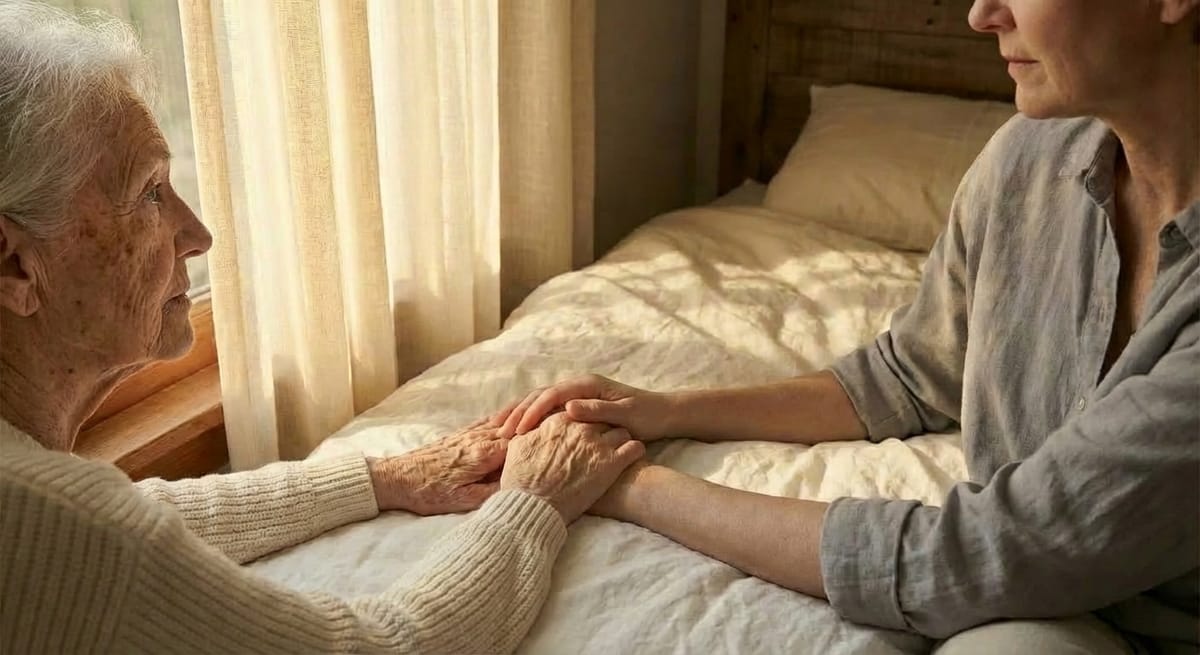
What does not need to be said: anything that feels forced, or that is more for your comfort than for theirs. You do not need to fill the silence. You do not need to say anything wise or memorable. Sitting quietly, holding a hand, smoothing a blanket, reading aloud from something they loved. These things carry meaning.
If they are still awake and responsive, follow their lead. Some people in hospice want to talk about everything. Others want distraction. Others want quiet. The goal is not to have the right conversation. It is to remain.
Siblings and Family Dynamics
Hospice often surfaces longstanding family tensions, especially around who is doing what and who is making decisions. Try to divide tasks in a way that matches each person's strengths. The person who is good in a crisis should be the point of contact with the nurse. The person who is good at logistics should handle food and schedules. The person who the dying person most wants near should be there as much as possible.
Communication among family members matters more than most families expect it to. Even a brief group text at the end of the day can reduce misunderstandings.
Caring for Yourself
You cannot be present for someone you love if you collapse. Sleep, when you can. Accept help with meals and logistics when it is offered. Give yourself permission to step outside, even briefly. The American Psychological Association notes that caregiver grief and caregiver exhaustion are closely linked, and that basic self-care during bereavement is not self-indulgence. It is sustainability.
| What Helps Most Families | What Tends to Make It Harder |
|---|---|
| Accepting concrete offers of help (meals, errands) | Trying to appear strong for everyone else |
| Maintaining one or two basic routines | Isolating from all social contact |
| Naming feelings out loud with someone trusted | Avoiding all conversation about the death |
| Keeping visits with the hospice social worker | Delaying all practical decisions indefinitely |
| Stepping outside daily, even briefly | Staying at the bedside without breaks |
After the Death: The First Hours and Days
When the death occurs, the hospice nurse will come to the home, confirm the death, and contact the attending physician. This is a process that typically takes one to two hours. You do not need to do anything during this time except be with your family, and with your person, for as long as you need.
The hospice team will ask you when you are ready to contact the funeral home. Ready does not mean soon. It means when you are ready. That might be an hour. It might be several hours. You are in charge of this room.
In the days that follow, you will face decisions about final arrangements. Burial, cremation, service planning, notifications. Some of these have time-sensitive components. Most do not. Your hospice social worker can help you understand which decisions require action and which can wait.
For families who choose cremation, the funeral home will manage the cremation process and return the cremated remains to you. Some families know exactly what they want to do with those remains. Many do not, and that is entirely normal. There is no schedule. There is no right choice.
Some families who choose cremation later find comfort in the idea of holding something tangible, something that invites the kind of daily presence that an urn stored on a shelf does not. Parting Stone offers a process that transforms cremated remains into smooth, holdable solidified remains. It is not the right choice for every family. But it is worth knowing it exists. When you are ready to explore what that might look like, we are here.
Delia, a palliative care physician from Baltimore, Maryland, wrote this after her father died: "I'm a palliative care physician and thought I understood death and grieving. Yet when my own dad died I felt gutted. The parting stones have been a fundamental part of my family's grieving process. We hold them, display them, tell others about them, and leave them in places that were meaningful to my dad. I've even mentioned them on my podcast. I highly recommend them for any grieving family." Even those who spend their careers accompanying others through loss discover that their own grief asks something new of them.
Hospice Bereavement Support: You Are Not Alone After
Most families do not realize that hospice care does not end when the patient dies.
Under Medicare regulations and standard hospice practice, bereavement support is provided to surviving family members for up to 13 months after the death. This typically includes:
- Scheduled phone calls from a bereavement counselor
- Grief support groups organized by the hospice organization
- Referrals to grief therapy or community mental health resources
- Memorial events hosted by the hospice team
This support is part of what you have already paid for. Use it.
The National Hospice and Palliative Care Organization notes that grief after a hospice death can be shaped by the period of anticipatory grief that precedes it. Some families feel relief first, and then guilt about the relief, and then grief. Others feel the full weight of loss arrive weeks after the death, when the activity fades and the silence becomes real. There is no expected arc.
Jean from Colchester, Vermont, described her experience this way: "Losing my mom was one of the toughest things I've ever been through. It doesn't matter that she had lived a full life, and lived to almost ninety. I was not ready to let her go. Having these stones to be able to carry with me has made me always feel like mom is close by. I put them in my coat pockets and it is always such a treat to reach in and feel the stone. Instantly brings me peace. And gratitude." For Jean, the tangible connection she found weeks after her mother's death became part of how she navigated what came next. Every family finds their own version of this.
If you are looking for additional support beyond what your hospice team provides, the following organizations offer grief resources at no cost:
- Hospice Foundation of America, which maintains an online grief resource library and telehealth support directory
- What's Your Grief, a grief education platform run by licensed counselors
- GriefShare, which offers in-person and online support groups
A Closing Note
If you read this entire article, you were looking for something. Maybe information. Maybe reassurance. Maybe just the presence of someone who acknowledges how heavy this is.
That took something. And it is worth naming.
You are trying to show up for someone you love during one of the hardest stretches of a human life. You do not have to do it perfectly. You do not have to say the right things or feel the right things or grieve on any timeline other than your own.
Being here, trying to understand, trying to prepare: that is an act of love. It counts.
When you need more support, in your own time, it is there.
How to Support a Loved One Through Hospice: A Practical Guide
Step 1: Learn the team's names and your point of contact
In the first 48 hours, identify the nurse who will be your primary contact and save their number. Know the after-hours line. This one step removes a significant source of anxiety.
Step 2: Create a simple daily log
Note the medications given, any changes in condition, and questions that come up. This is especially helpful if multiple family members are caregiving in shifts.
Step 3: Set up a family communication rhythm
Designate one person to send brief daily updates to the broader family. This reduces repeated calls to the caregiver and prevents information gaps from creating conflict.
Step 4: Identify what you need to be present
What do you need physically and emotionally to stay present over days or weeks? Identify two or three people outside the immediate family who can handle specific logistics: groceries, pet care, mail, work notifications.
Step 5: Ask the social worker one question per visit
Hospice social workers are underused resources. Come to each visit with one practical or emotional question. They are there to help you navigate exactly this.
Step 6: Give yourself permission to leave
Stepping outside, sleeping at home, eating a real meal: these are not failures of presence. They are the things that allow you to come back.
Frequently Asked Questions
What are the stages of hospice care?
Hospice care generally moves through four stages: admission and stabilization, the maintenance phase where symptoms are managed, the active dying phase, and the final hours. Each stage involves different levels of care and different physical signs. The hospice team guides families through each transition.
How long can someone be on hospice?
Medicare and most insurers certify hospice in 90-day periods, renewable as long as a physician certifies a prognosis of six months or less. Some patients remain enrolled for months or longer. Others pass within days of admission. There is no standard or expected timeline.
What are the signs that someone in hospice is dying?
The active dying phase typically begins hours to days before death. Common signs include mottled skin, irregular or labored breathing, decreased urine output, difficulty swallowing, and withdrawal from surroundings. Your hospice nurse will explain each of these changes as they occur and can help you understand what is normal.
What does hospice actually do for the patient?
Hospice teams provide pain management, symptom control, medication oversight, emotional support, spiritual care, and help with personal care. The team includes a nurse, physician, home health aide, social worker, chaplain, and bereavement counselor. The goal is comfort, dignity, and quality of life.
How do I support a family member in hospice emotionally?
Presence matters more than words. Saying "I love you" and "I'm here" is enough. Follow the patient's lead on conversation. Silence shared is not awkward. It is connection. If they are still communicative, ask what they want, and then do that, without pressure or agenda.
What happens after a loved one passes in hospice?
The hospice nurse will come to the home, pronounce the death, and contact the attending physician. The body may remain in place for as long as the family needs. The hospice team will coordinate with the funeral home when the family is ready. Bereavement support from the hospice team continues for up to 13 months after the death.
What happens to cremated remains after a hospice death?
Families who choose cremation work with the funeral home to receive the cremated remains. What happens next is entirely the family's decision, in their own time. Some families scatter, some display, some carry. Some discover options like solidified remains that allow for a different kind of ongoing connection. There is no requirement, no deadline, and no wrong choice.
Does hospice provide emotional support for families?
Yes. Hospice teams include social workers, chaplains, and grief counselors who support not just the patient but the entire family, during the care period and through bereavement support for up to 13 months after the loss. This support is a standard component of hospice services.
References
American Psychological Association. (2023). Grief: Coping with the loss of your loved one. https://www.apa.org/topics/grief
Centers for Medicare and Medicaid Services. (2024). Medicare hospice benefits. https://www.medicare.gov/coverage/hospice-care
Centers for Medicare and Medicaid Services. (2024). Hospice coverage. https://www.cms.gov/medicare/coverage/hospice-coverage
Hospice Foundation of America. (2024). How hospice works. https://hospicefoundation.org
National Hospice and Palliative Care Organization. (2024). What is hospice care? https://www.nhpco.org/patients-and-caregivers/about-hospice-care
National Institute on Aging. (2023). What are palliative care and hospice care? https://www.nia.nih.gov/health/end-of-life
Nielsen, M. K., Neergaard, M. A., Jensen, A. B., Bro, F., and Guldin, M. B. (2019). Psychological distress, health, and socio-economic factors in caregivers of terminally ill patients: A systematic review. Journal of Palliative Medicine, 22(5), 592-598. https://pubmed.ncbi.nlm.nih.gov/26887588
Rando, T. A. (1986). Loss and anticipatory grief. Lexington Books. [classic academic reference; print only]
What's Your Grief. (2024). Anticipatory grief: Grieving before the loss. https://whatsyourgrief.com/anticipatory-grief