
How to Ship Cremated Remains?
Shipping cremated remains requires USPS Priority Mail Express with special labeling, sealed packaging, and required documentation, though some families choose solidified remains for simpler logistics without postal restrictions. Understanding these federal requirements ensures your loved one's remains arrive safely and legally at their destination. The U.S. cremation rate reached 61.9% in 2024 according to the National Funeral Directors Association, meaning millions of families annually face decisions about memorial arrangements including potential shipping needs (NFDA, 2024). Parting Stone's solidification process provides families with an alternative that eliminates many of these shipping complexities while preserving the full memorial significance of their loved one's remains.
Federal Requirements for Shipping Cremated Remains
Shipping cremated remains through the United States Postal Service involves specific federal regulations designed to ensure dignity and safety during transport. The USPS maintains exclusive authority over cremated remains shipping, meaning private carriers like FedEx or UPS cannot legally handle these shipments under federal law.
The most critical requirement involves using only USPS Priority Mail Express service for all cremated remains shipments. This premium service level provides tracking capabilities, insurance coverage, and expedited delivery that other postal services cannot guarantee. Regular mail services, ground shipping, or standard priority mail do not meet federal standards for human remains transport.
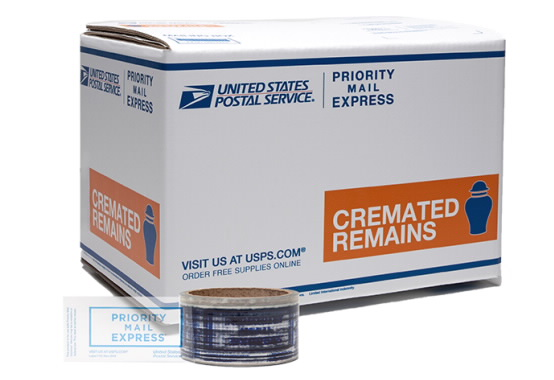
Effective March 1, 2025, new USPS requirements mandate that all cremated remains must be shipped using special Priority Mail Express cremated remains branded boxes (BOX-CRE) provided by the Postal Service (ICCFA, 2025). This requirement replaces the previous option of using any box with Label 139 markings.
Packaging requirements demand a sealed, sift-proof primary container that prevents any spillage during handling and transport. The cremated remains must remain in their original sealed urn or be transferred to an approved shipping container that meets USPS specifications. Documentation requirements include certified copies of the death certificate and cremation certificate.
For instance, families seeking simpler alternatives often discover that solidified remains eliminate these federal shipping restrictions entirely. Parting Stone's transformation process creates stone-like forms that ship as regular packages without special postal requirements or documentation.
International Shipping Challenges and Restrictions
International shipping of cremated remains presents significantly more complex regulatory landscapes than domestic transport. Each destination country maintains its own restrictions, documentation requirements, and prohibition policies that can create substantial barriers for grieving families.
Many countries prohibit the importation of human cremated remains entirely, while others require extensive documentation from multiple government agencies. Countries like Japan, South Korea, and several European nations demand consular certificates, health department clearances, and embassy approvals that can take weeks or months to obtain.
Airline policies add another layer of complexity for families attempting to hand-carry cremated remains internationally. Each carrier maintains specific container requirements, advance notification policies, and documentation standards that may conflict with destination country regulations. The Transportation Security Administration requires that containers must be scannable, with opaque containers prohibited through security.
Using Parting Stone's solidified remains, families can travel internationally with memorial stones in standard luggage without special documentation, customs declarations, or airline restrictions. The stones appear as natural mineral specimens to customs officials and airport security.
Solidified Remains: A Simpler Shipping Alternative
Solidified remains represent a complete alternative to traditional cremated remains that eliminates the shipping complexities families face with conventional ashes. Through a scientific process validated by Los Alamos National Laboratory, Parting Stone transforms cremated remains into 40-80+ smooth, stone-like forms that maintain the full memorial significance while simplifying logistics dramatically.
The transformation process preserves 100% of the original cremated remains while converting them into a durable, solid form that ships like regular packages. Unlike traditional cremated remains requiring special postal services and documentation, solidified remains can be shipped through any carrier including FedEx, UPS, or standard postal services without restrictions.
International travel becomes substantially simpler with solidified remains since they require no special customs documentation, health department clearances, or embassy approvals. The stone form prevents spillage concerns, eliminates special handling requirements, and allows families to easily divide portions among multiple recipients.
Through Parting Stone's streamlined approach, families receive their loved one in a form designed for easy sharing, travel, and permanent memorialization without the anxiety-inducing aspects of shipping conventional cremated remains. For example, a family seeking to transport memorial remains to Ireland faces Irish government documentation requirements with traditional ashes, while solidified remains travel as regular stones without special procedures.
Packaging and Documentation Step-by-Step
Proper packaging of cremated remains requires careful attention to federal specifications and safety protocols established by USPS Publication 139. The process begins with verifying the primary container meets USPS standards for sealed, leak-proof construction.
Primary Container Requirements:
- Sealed urn or approved shipping container with tight-fitting lid
- Sift-proof construction preventing any spillage during transport
- Appropriate size for shipping box with adequate cushioning space
- Clear identification labels attached to container exterior
New BOX-CRE Requirements (Effective March 2025):
- Must use USPS-supplied Priority Mail Express cremated remains boxes
- Available in two sizes, ordered free from USPS.com
- Replaces previous Label 139 requirements for any box
- Designed to improve visibility and handling throughout postal network
Secondary Protection Protocol:
- Place primary container in sturdy plastic bag with return addresses
- Include copies of death certificate and cremation certificate inside bag
- Add contact information for both sender and recipient
- Seal bag securely to prevent document loss during handling
Documentation preparation involves gathering required certificates and completing postal service forms accurately. Death certificates must be certified copies from the issuing state or county, not photocopies or uncertified documents.
Using Parting Stone's collection kit eliminates these complex packaging requirements entirely. The service provides all necessary materials and instructions for safely sending cremated remains to their facility, then returns the solidified remains in simple protective packaging requiring no special labeling or handling.
Frequently Asked Questions About Shipping Cremated Remains
How long does shipping cremated remains take?
Shipping cremated remains through USPS Priority Mail Express typically takes 1-2 business days for domestic destinations, though processing time for documentation verification can add 2-3 additional days before shipment. International shipping timelines vary significantly based on destination country requirements and customs processing, ranging from 5-21 business days total.
The most significant time factor involves document preparation and verification rather than actual transit time. Many families underestimate this preparation phase when planning memorial services or scattering ceremonies.
What carriers can ship cremated remains?
Only the United States Postal Service can legally ship cremated remains in the United States. Federal regulations explicitly prohibit private shipping companies like FedEx, UPS, DHL, and other carriers from transporting human cremated remains under any circumstances.
This USPS monopoly often creates inconvenience for families accustomed to using preferred shipping carriers or seeking competitive pricing. The restriction applies regardless of packaging quality, documentation completeness, or insurance coverage levels.
Can I hand-carry cremated remains on airplanes?
Airlines generally permit cremated remains as carry-on items with advance notification and proper documentation, though each carrier maintains specific policies regarding container types and advance notice requirements. TSA regulations allow cremated remains in carry-on luggage when contained in approved urns that can pass through security screening.
Metal urns or containers with complex designs may require additional inspection or alternative arrangements. International flights face additional complexity with destination country customs requirements that can prevent entry even with proper airline approval.
What happens if cremated remains are damaged during shipping?
USPS provides insurance coverage for Priority Mail Express shipments up to declared value, though the emotional significance of cremated remains cannot be replaced through monetary compensation. Proper packaging significantly reduces damage risk, but accidents can occur during handling and transport.
Container damage typically involves cracking or breaking of ceramic or glass urns rather than loss of the cremated remains themselves. USPS policies require immediate reporting of any damage for insurance claim processing.
Are there states that prohibit shipping cremated remains?
No states prohibit shipping cremated remains outward, though some maintain specific documentation requirements for remains leaving their jurisdiction. States like California, New York, and Florida require permits or certificates for cremated remains transport that must be obtained before shipping.
These state-level requirements add complexity to the federal shipping process but do not create absolute prohibitions. The documentation typically involves health department permits, funeral director certifications, or state-issued transport certificates.
What countries allow cremated remains imports?
Cremated remains import policies vary dramatically by country, with some nations maintaining complete prohibitions while others requiring extensive documentation and health clearances. European Union countries generally permit imports with proper documentation, while many Asian and Middle Eastern nations prohibit human remains imports entirely.
Countries permitting cremated remains imports typically require consular certificates, health department clearances, and embassy approvals obtained before shipment. The documentation process can take several months and involves substantial fees.
How much does shipping cremated remains cost?
USPS Priority Mail Express pricing for cremated remains typically ranges from $45-85 for domestic shipments, depending on distance and package weight. Insurance coverage adds $15-25 to the base shipping cost, though most families choose maximum coverage given the irreplaceable nature of the contents.
International shipping costs vary significantly based on destination country and required documentation. Basic shipping charges range from $85-200, while document processing fees, embassy certificates, and customs clearances can add substantial costs.
What size packages are allowed for cremated remains?
USPS allows cremated remains packages up to 70 pounds total weight and maximum dimensions of 108 inches combined length and girth. Most cremated remains shipments weigh 8-15 pounds including protective packaging, well within postal service limits.
Package sizing must accommodate proper cushioning materials around the primary container while meeting postal service dimension restrictions. Standard adult cremated remains require containers ranging from 180-220 cubic inches.
| Aspect | Cremated Remains Shipping | Solidified Remains Shipping |
|---|---|---|
| Allowed Carriers | USPS only | All carriers (FedEx, UPS, USPS) |
| Service Levels | Priority Mail Express only | Standard ground, overnight, priority |
| Documentation | Death cert, cremation cert, state permits | None required |
| International Shipping | Embassy approvals, health clearances | Standard customs procedures |
| Packaging Requirements | Special BOX-CRE containers, sift-proof | Standard protective packaging |
Based on USPS Publication 139 requirements and Postal Service regulations
Customer Experience: Shipping and Travel Stories
Real families who have chosen solidified remains consistently report dramatically simplified travel and shipping experiences compared to traditional cremated remains. Customer testimonials highlight practical advantages that extend far beyond simple convenience.
One customer shared their international travel experience: "We were able to take Dad with us to Ireland without any paperwork hassles. The stones went right in our carry-on bag." This represents families who prioritize travel and mobility in their memorial decisions without facing embassy documentation and airline coordination requirements.
Another family described shipping simplicity: "Shipping some stones to my brother was so much easier than we expected. No special forms or expensive overnight shipping required." This reflects the common pattern where families want to share memorial elements among geographically dispersed relatives without complex logistics coordination.
One testimonial provided insight into ongoing travel integration: "Mark wasn't able to travel for many years before his death at 48 due to his illness. Since his death my daughter and I have shared dozens of his stones with those who loved him on their travels. They have placed stones in countries and oceans all over the world."
The contrast becomes particularly clear in testimonials describing traditional cremated remains anxiety. Multiple families described feeling uncomfortable with the idea of "mailing" their loved one through postal services, preferring the emotional simplicity of shipping memorial stones that maintain full significance.

Professional Guidance for Families
Families considering shipping cremated remains benefit from professional support during the decision-making process, particularly given the emotional complexity combined with regulatory requirements. Funeral directors experienced in shipping arrangements can provide valuable guidance, though the process remains challenging even with professional assistance.
The most effective approach involves early conversation about shipping intentions during funeral planning rather than discovering requirements after cremation is complete. Many families express surprise at shipping complexity, documentation requirements, and cost factors that impact memorial planning significantly.
Professional documentation services exist in most metropolitan areas for families unable to navigate embassy requirements, health department clearances, and international shipping procedures independently. These services typically charge $200-500 for complete documentation handling, though processing timelines remain subject to government agency schedules.
When considering international memorial experiences, families should research destination country policies well in advance of planned travel. Some restrictions cannot be overcome through additional documentation, while others require months of advance preparation that may conflict with desired memorial timelines.
For families seeking simpler alternatives, Parting Stone's solidification service provides professional guidance throughout the transformation process while eliminating shipping complexity entirely. The 8-10 week processing timeline allows families to plan memorial experiences without regulatory constraints, documentation delays, or shipping restrictions that complicate traditional cremated remains transport.
References
Cremation Association of North America. (2025). Transport of cremated remains. https://www.cremationassociation.org/transport.html
International Cemetery, Cremation & Funeral Association. (2025, February 21). Washington update: USPS updates requirements for shipping cremated remains. https://iccfa.com/blog/washington-update-usps-updates-requirements-for-shipping-cremated-remains/
National Funeral Directors Association. (2024, July 25). U.S. cremation rate is projected to climb to 61.9% in 2024. https://nfda.org/news/media-center/nfda-news-releases/id/8944/us-cremation-rate-is-projected-to-climb-to-619-in-2024
National Funeral Directors Association. (2025). Cremation statistics. https://nfda.org/news/statistics
Transportation Security Administration. (n.d.). Crematory container. https://www.tsa.gov/travel/security-screening/whatcanibring/items/crematory-container
United States Postal Service. (2025, January). Publication 139: How to package and ship cremated remains. https://about.usps.com/publications/pub139.pdf
United States Postal Service. (2025, March 1). There's a new rule for shipping cremated remains. USPS Employee News. https://news.usps.com/2025/03/01/theres-a-new-rule-for-shipping-cremated-remains/
United States Postal Service. (2019). New shipping process for cremated remains. Postal Bulletin. https://about.usps.com/postal-bulletin/2019/pb22529/html/info_009.htm