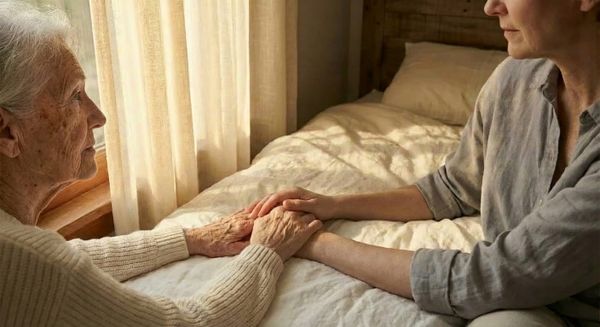
How to Ask for Help When Grief Makes You Feel Helpless


Key Takeaways
- Grief affects your brain's capacity for decision-making and communication, making it genuinely harder (not weak) to ask for help when you need it most.
- Common barriers to asking for grief support include fear of burdening others, shame about vulnerability, and believing your problems aren't serious enough to warrant help.
- Specific, actionable requests are easier for others to fulfill than general offers of "let me know if you need anything."
- Support with grief extends to all types of decisions, including practical matters like what to do with cremated remains, and seeking input is a healthy part of the healing process.
- About 30% of bereaved individuals report wanting more support than they receive, and actively offering help addresses this unmet need better than waiting to be asked.
Reflections on love, loss, and the ways we carry them.
There is a particular kind of silence that settles around an urn on a shelf. The silence of postponed decisions, of love you don’t quite know what to do with. I see this often in my practice: the way grief makes even the smallest choices feel impossibly heavy. And yet most people believe they should be able to handle it alone.
But grief alters the brain. It affects memory, decision-making, even the ability to speak clearly. What we call “grief brain” is a real biological overload, not a personal shortcoming. Add the quiet shame many feel about “burdening” others, and reaching out becomes the hardest step of all.
A client, let’s call her Anna, once sat across from me, twisting a tissue in her hands. Her husband’s urn had been on her bookshelf for three years. “I kept telling myself it wasn’t important,” she said. “But every morning I’d look at it and feel… stuck.” When she finally asked for help, something shifted. Together, she explored options, talked through memories, and eventually chose to share Parting Stone’s smooth, warm stones with her children. “It felt like movement,” she told me later. “Like breathing again.”
Asking for support isn’t weakness. It’s biology. It’s love. And it’s often the first moment of relief.
If you’re reading this and feeling that same stuckness, the hesitation, or the heaviness—start small. Share one truth with one trusted person. Let someone sit beside you in the uncertainty.
You were never meant to carry grief alone.
Cathy Sanchez Babao
Parting Stone Grief Coach
The urn sits on your shelf. Again. You've looked at it every day for months, maybe years, knowing you need to do something. But the weight of deciding what feels paralyzing, and the thought of asking someone to help you figure it out feels impossible. You tell yourself you should be able to handle this alone.
If you're struggling to ask for help while grieving, you're experiencing something that research shows is both common and deeply rooted in how grief affects your brain and your sense of self. This isn't about weakness. It's about navigating one of life's hardest experiences while dealing with real psychological and social barriers that make reaching out genuinely difficult.
Many people find that understanding why grief makes help-seeking so hard is the first step toward allowing yourself to reach out. What follows are insights from grief research, practical strategies for asking, and validation that needing support doesn't diminish your strength or your love.

A New Way to Hold Close What Matters Most
We transform cremated remains into beautiful, touchable stones that bring comfort when you need it. Something you can hold, share, and keep close.
Why Grief Makes Asking for Help So Hard
When you're grieving, your brain is working overtime. Research has identified that bereavement creates measurable changes in cognitive function, immune response, and stress hormone regulation (O'Connor, 2019). What you're experiencing isn't just emotional difficulty. It's your entire system under profound stress.
This cognitive load, often called "grief brain," affects your ability to make decisions, communicate clearly, and assess what kind of help you actually need. You're not imagining that everything feels harder right now. It genuinely is.
Psychological barriers compound these biological challenges. Research with bereaved students found that common obstacles to grief asking for help include feelings of being a burden to others, perceiving their problems as not serious enough to warrant support, cultural stigma around vulnerability, and feelings of guilt about needing help (Pitman et al., 2018; Tureluren et al., 2022).
Pride and shame often intersect in ways that make vulnerability feel impossible. You might think, "I should be stronger than this," or "Everyone else manages their grief without falling apart." These thoughts reflect internalized beliefs about self-reliance that don't account for the reality of how grief affects human functioning.
Social conditioning plays a role too. Many of us learned that asking for help signals weakness, that we should solve our own problems, or that truly capable people don't need support. Grief exposes the falseness of these beliefs, but that doesn't make them easier to dismantle when you're already exhausted.
The fear of burdening others often feels particularly acute. You might worry that friends and family are tired of hearing about your grief, that they've already done enough, or that asking for more support will damage relationships. Research suggests these concerns are often more about your own vulnerability than about others' actual capacity or willingness to help (Sarper & Rodrigues, 2024).
Recognizing When You Need Support
Grief support isn't one-dimensional. You might need different kinds of help at different times, and recognizing what you need requires a kind of self-awareness that grief brain makes challenging.
- Emotional support looks like having someone listen without trying to fix your feelings or offer unsolicited advice. This is someone who can sit with you in your sadness, validate that what you're experiencing is real and difficult, and remind you that grief doesn't follow a timeline.
- Practical support addresses the concrete tasks that feel overwhelming. This might be help with meals, household tasks, childcare, or navigating paperwork. It could also include support with decisions about memorial options or what to do with your loved one's belongings.
- Professional support from grief counselors, therapists, or support groups provides specialized tools and frameworks for understanding grief. Research shows that perceived social support acts as a buffer against the most severe grief symptoms, with those who have stronger support systems reporting better outcomes (Gesi et al., 2020; Mason et al., 2020).
Decision-making support helps when you're facing choices that feel impossible to make alone. Many people find themselves paralyzed by decisions about memorial services, estate matters, or what to do with cremated remains. Having someone help you think through options without pressure can be invaluable.
Consider these questions:
- Are you having trouble completing basic daily tasks?
- Do you find yourself avoiding conversations or situations because they're emotionally overwhelming?
- Have you been making decisions while feeling numb or detached, only to regret them later?
- Are you experiencing physical symptoms like exhaustion, changes in appetite, or disrupted sleep?
- Do you feel isolated or like no one understands what you're going through?
If you answered yes to any of these, you're experiencing signals that support could help. That doesn't mean something is wrong with you. It means you're carrying a heavy weight and could benefit from sharing the load.
Belinda, Ithaca, New York 🖤 found that support made all the difference: "Since grieving is an ongoing process for me and others who shared in our loss, it has changed over time. I know that small parts of my loved one are in places that were important in their life. My ability to carry a smooth stone of remains in a pocket has been a helpful comfort over time. Close relatives and friends were offered the opportunity to share in having a memorial stone, and many expressed gratitude for being able to do so."
Your support needs will change. What you need in the immediate aftermath of loss differs from what helps six months or two years later. Some people need more help early on, while others find themselves needing more support as the initial shock wears off and the permanence of the loss settles in.
 Parting Stone Editors
Overcoming Internal Barriers to Help-Seeking
The shift from recognizing you need help to actually asking for it requires challenging some deeply held beliefs about vulnerability and self-reliance.
Vulnerability isn't weakness. Research in affective neuroscience shows that the human grief system evolved specifically because of our need for social bonds (Panksepp's neuro-affective model). Your need for connection and support during loss is biological, not a character flaw.
Reframing help-seeking as strength rather than weakness starts with understanding that asking for help requires more courage than suffering alone. It means you're prioritizing your wellbeing and healing over protecting an image of invincibility.
The "burden" narrative deserves particular attention because it's one of the most common barriers to grief asking for help. You might tell yourself that your friends and family have their own problems, that you've already asked for too much, or that you should handle this yourself.
Consider this alternative perspective: When someone you care about is struggling, do you see their request for help as a burden? Or do you feel honored that they trust you enough to be vulnerable? Most people genuinely want to support those they care about but don't know how to help unless you tell them what you need.
Research on social support in grief has found that people who receive adequate support report more personal growth alongside their grief symptoms (Tureluren et al., 2022). Supporting someone through grief deepens relationships rather than diminishing them.
Reciprocity in relationships isn't always immediate or symmetrical. You might not be able to return the specific support someone gives you during your grief, but relationships built on genuine care don't operate on a ledger system. The person who brings you meals this month might need your support in a different way years from now.
Stephanie, Sun City, Kansas 🖤 described how sharing with others helped everyone: "It's lovely for our children, grandchildren and myself. We all have a remembrance of a wonderful man who we all loved dearly. The stones are a tangible symbol of our love for a kind amazing man. It's so much nicer to share the stones with family rather than one urn sitting on a shelf. The stones bring comfort to us all."
Cognitive restructuring techniques can help when your thoughts become barriers. When you notice yourself thinking "I shouldn't need help" or "This is too much to ask," try replacing those thoughts with more accurate ones: "Needing help during grief is normal and human" or "People who care about me want to support me."
 Parting Stone Editors
How do you ask for help when grieving?
Start by identifying what you actually need. Vague offers of "let me know if you need anything" often go unmet because grief brain makes it hard to translate overwhelming feelings into specific requests. Think about concrete, actionable things that would genuinely help.
Use clear, direct language when asking. Instead of hinting or hoping someone will notice you're struggling, try: "I'm having a really hard time right now and could use some help. Would you be able to [specific request]?"
Make your requests specific and time-bound. "Could you bring dinner on Tuesday evening?" is easier for someone to fulfill than "I need help with meals." Specific requests remove the guesswork and make it simpler for people to say yes.
Sample Scripts for Different Types of Support:
- For emotional support: "I'm struggling today and could really use someone to talk to. Do you have 30 minutes to just listen? I don't need advice, just someone to hear me."
- For practical assistance: "I'm overwhelmed by household tasks right now. Would you be able to help with laundry this weekend, or could you recommend someone who does cleaning services?"
- For decision-making support: "I need to make some decisions about memorial options and I'm feeling really stuck. Would you be willing to sit with me while I talk through the choices? I'd value your perspective."
- For professional help connections: "I think I need to talk to a grief counselor, but I'm not sure where to start. Do you know anyone who specializes in bereavement support, or could you help me research options?"
Communication channels matter. Some people find it easier to reach out via text message because it feels less intense than a phone call. Others need the human connection of hearing someone's voice. Email works well when you need to explain a complex situation or give someone time to respond thoughtfully. In-person requests work best when you need immediate support or when the subject is particularly sensitive.
Consider who you're asking. Different people in your life might be better suited for different types of support. A practical friend might excel at organizing logistics, while an emotionally intuitive friend might be better for processing feelings. Your grief counselor or therapist offers professional expertise that friends and family can't provide.
Rebecca, Vernon, Connecticut 🖤 found that family support was transformative: "I feel like Justin is with me wherever I go. This is a tangible way to hold him and bring him with me. Even to leave a stone at places that were special to him. How beautiful the finished product was and how much peace it brought my family."
Batch your requests when possible. If you're reaching out to multiple people, consider creating a simple way for them to sign up for specific tasks. Meal trains, ride-sharing calendars, or task lists help coordinate support without requiring you to manage everything yourself.
Remember that asking once doesn't mean you can't ask again. Support needs fluctuate throughout grief. You might need less help for a while and then find yourself needing more support around anniversaries, birthdays, or other milestone dates.
 Parting Stone Editors
Accepting Help When It's Offered
Sometimes the hardest part of asking for help is actually accepting it when people respond. Your instinct might be to minimize your needs or to decline offers that feel "too much."
Practice saying yes even when it feels uncomfortable. When someone asks "What can I do to help?" and you know they genuinely mean it, tell them something specific rather than saying "I'm fine" or "I'll let you know."
Direct help toward what you actually need rather than what you think you "should" need. If someone offers to help clean your house but what you really need is company while you sort through your loved one's belongings, it's okay to say that.
Gracious receiving is its own form of generosity. Allowing someone to help you gives them the opportunity to make a meaningful contribution during a difficult time. For many people, being able to do something concrete for someone who's grieving provides a sense of purpose and connection.
Setting boundaries remains important even when accepting help. Not all offers of support will be helpful, and it's okay to decline assistance that doesn't serve your actual needs. If someone's "help" comes with expectations, judgment, or strings attached, you can say, "Thank you for the offer, but I'm managing that aspect myself."
Cheryl, Adrian, Michigan 🖤 shared how meaningful tangible support can be: "I am able to keep it close by me and when I'm feeling sad or lonely I can hold the stone close to my heart!!! I find the stones are so much better than having ashes in an urn. You can actually hold the stones and feel close to your loved one."
The cremated remains of Garth's mother felt meaningless sitting in his clothing closet for 2 decades. Learn how solidified remains helped dissolve the relationship barrier he felt with her and integrate her memory into daily life.
When Practical Decisions Feel Overwhelming
Grief doesn't just affect your emotional state. It impacts your ability to make practical decisions, including what to do with your loved one's cremated remains. Many people find themselves stuck in a kind of paralysis, knowing they need to make a decision but unable to move forward.
This is exactly where asking for help becomes essential. Having someone to talk through options with you, without pressure or judgment, can break through the paralysis. They don't need to make the decision for you, but their presence and perspective can help clarify what feels right.
Among the 75 million Americans currently storing cremated remains at home, many are waiting not because they don't care, but because the weight of choosing feels too heavy to bear alone. The urn sitting on your shelf doesn't represent lack of love or respect. It represents the difficulty of making permanent decisions during a time of temporary cognitive overload.
For some families, support looks like having conversations about what their loved one would have wanted. For others, it means exploring memorial options together, understanding that there's no single "right" choice.
Solidification of cremated remains represents one option that some families find helpful when traditional urns or scattering don't feel quite right. This process transforms ashes into 40-80+ smooth, tangible stones that can be held, shared with family members, or placed in meaningful locations.
Chris, St Charles, Illinois 🖤 found that this alternative addressed decision paralysis in his family: "While my mother had left instructions to be cremated, but she left little else in regards to what to do after that. When the Parting Stone idea was presented to us, it was like a weight was lifted off of our shoulders. The ability to take our loved one with us to our family's favorite places, and leave a little part behind, is priceless."
Unlike traditional memorial products that serve as additions to or containers for ashes, solidified remains offer a complete alternative. The full cremated remains are returned in solid form, providing families with something tangible they can interact with in ways that feel more natural than a sealed urn.
Many people find that having someone help them explore whether this or other memorial options align with their values and needs is part of the grief support process itself. The decision about what to do with remains isn't separate from grief work. It's one aspect of how you honor your loved one and integrate your loss into your life moving forward.
The 8-10 week processing timeline for solidification services means families can take time to consider whether this option resonates without pressure. At $2,495 for human remains or $1,195 for beloved pets, families receive a complete alternative that can be shared among family members or kept together in meaningful ways.
Jennifer, Omaha, Nebraska 🖤 expressed how family input made the decision possible: "Parting Stones has brought our family an unmeasurable and unexpected comfort. Losing our mom was heartbreaking, but having her remains turned into beautiful, solidified stones has given us a sense of peace and closeness we didn't know was possible. Each of us - my siblings, Dad, and I - were able to share and display her stones in our homes, and it feels like she's truly with us."
The point isn't that solidified remains are right for everyone. It's that having support to explore what feels meaningful to you, whether that's scattering, burial, keeping ashes in an urn, solidification, or something else entirely, is part of honoring both your loved one and your own grieving process.

Moving Forward with Support
Asking for help when grief makes you feel helpless isn't about fixing your grief or speeding through it. It's about giving yourself the resources to carry grief's weight without being crushed by it.
The research is clear: perceived social support significantly mitigates risk in bereaved individuals (Levi-Belz & Lev-Ari, 2019). Those who receive adequate support, whether emotional, practical, or professional, report better outcomes not just in terms of grief symptoms but also in measures of personal growth, meaning-making, and life satisfaction.
But support doesn't happen automatically. Despite the common phrase "Let me know if you need anything," people often need direct asks to know how to help. Waiting for others to figure out what you need places the burden on you to both struggle alone and somehow magically communicate your needs without asking.
Different types of support serve different purposes. Emotional support validates your experience and reminds you you're not alone. Practical support reduces the cognitive and physical load. Professional support provides specialized tools and frameworks. Decision-making support helps you think through choices when your brain feels foggy.
Kate, San Jose, California 🖤 described finding unexpected comfort through tangible connection: "The stones have been invaluable in creating a memorial for each family member, including grandchildren, and also given to dearest friends. The simplicity and the huge impact of solace having the stones in special places and one always with me. I've also commissioned a glass piece to be made with a stone embedded. I'm never without a stone in my purse or pocket."
You don't have to do this alone. You were never meant to do this alone. The cultural narrative that strength means independence ignores the fundamental reality that humans are social beings who have always turned to community during life's hardest moments.
If reaching out still feels impossible, start small. One text message. One phone call. One honest conversation with one trusted person. You don't have to ask for everything at once. You don't have to have it all figured out before you reach out.
Grief changes over time, and so will your support needs. What helps today might not help next month, and what feels impossible to ask for now might become easier later. That's not only okay; it's expected.
Your grief deserves support. Your struggle deserves acknowledgment. Your needs deserve to be met. Asking for help isn't a sign that you're failing at grief. It's a sign that you're human, that you loved deeply, and that you're choosing to honor both your loss and your own wellbeing by reaching out.
You don't have to carry this weight alone.
Frequently Asked Questions
How do I know if I need professional help for grief or if I can manage with support from friends and family?
Consider professional grief support if you're experiencing persistent difficulty functioning in daily life, if grief symptoms aren't improving over time, if you're having thoughts of self-harm, or if you're dealing with complicated grief factors like traumatic loss or relationship ambivalence. Friends and family provide essential emotional connection, but grief counselors offer specialized expertise in navigating bereavement's psychological challenges. Many people benefit from combining both informal support networks and professional guidance, especially during the first year after loss.
What if I ask for help and people respond with unhelpful advice or platitudes?
Unhelpful responses to grief asking for help are common and usually come from discomfort rather than lack of care. You can redirect conversations by being specific about what you need: "I appreciate you wanting to help. Right now I don't need advice; I just need someone to listen." If someone repeatedly provides unhelpful support despite clear communication, it's okay to limit those interactions and seek support from people who can meet you where you are. Remember that not everyone will be equipped to support you in the ways you need, and that's about their capacity, not your worthiness of support.
How can I ask for help without feeling like I'm imposing on people who have their own problems?
Recognize that most people genuinely want to help but don't know how unless you tell them specifically. Research shows that supporting someone through grief often provides a sense of purpose and strengthens relationships rather than creating resentment. Frame requests as opportunities for connection rather than burdens, and remember that reciprocity in relationships isn't immediate or symmetrical. The person who helps you now might need different support from you in the future. If you're truly concerned about overburdening one person, consider spreading requests across your support network so no single individual carries everything.
Is it normal to need more help months or even years after the loss, not just in the immediate aftermath?
Absolutely. Many people find they need more support as the initial shock wears off and the permanence of loss settles in. Grief typically intensifies around anniversaries, birthdays, holidays, and major life transitions. The first year involves navigating every "first" without your loved one, but the second and third years bring their own challenges as you realize they won't be present for future milestones. Needing support long after the loss is not only normal; it reflects a realistic understanding of how grief works. Don't hesitate to reach out when you need help, regardless of how much time has passed.
What if I've already asked for help multiple times and I'm worried about asking again?
Ongoing support needs are a normal part of grief, and asking again doesn't mean you're "not healing properly." Be direct about your continuing needs: "I know I've asked for help before, and I'm finding I need support again. Would you be able to help with [specific request]?" If one person isn't available, reach out to others in your support network. Consider whether you might benefit from structured ongoing support like a grief support group or regular counseling sessions, which provide consistent help without requiring repeated individual asks.
How do I ask for help with decisions about memorial options when I'm not even sure what I want?
Start by asking someone to help you explore options without expectation of immediate decisions. Say something like: "I need to figure out what to do with the cremated remains, but I'm feeling really stuck. Would you help me research options and talk through what feels meaningful?" This opens the door to discovering what resonates without pressure to decide immediately. Many people find that having someone listen as they think out loud helps clarify their own values and preferences, even when they don't initially know what they want.
About the Editor
Cathy Sanchez Babao is a Grief Coach at Parting Stone, a grief educator, counselor, author, and columnist who has dedicated her career to helping individuals and families navigate loss. She writes the “Roots and Wings” column for the Philippine Daily Inquirer and is the author of Heaven’s Butterfly and Between Loss and Forever: Filipina Mothers on the Grief Journey. Cathy holds a B.S. in Business Administration and Management from Ateneo de Manila University and an M.A. in Family Psychology and Education from Miriam College, with advanced grief training at the Center for Loss & Life Transition and the Center for Prolonged Grief at Columbia University.
References
American Psychiatric Association. (2022). Prolonged grief disorder. Retrieved from https://www.psychiatry.org/patients-families/prolonged-grief-disorder
Eisma, M. C., & Stroebe, M. S. (2021). Rumination following bereavement: An overview. Bereavement Care, 40(3), 87-94.
Gesi, C., Carmassi, C., Cerveri, G., Carpita, B., Cremone, I. M., & Dell'Osso, L. (2020). Complicated grief: What to expect after the coronavirus pandemic. Frontiers in Psychiatry, 11, 489. https://www.frontiersin.org/articles/10.3389/fpsyt.2020.00489/full
Hogan, N. S., & Schmidt, L. A. (2002). Testing the grief to personal growth model using structural equation modeling. Death Studies, 26(8), 615-634.
Hospice Foundation of America. (2024). Research on grief and grieving. Retrieved from https://hospicefoundation.org/research-on-grief-and-grieving/
Levi-Belz, Y., & Lev-Ari, L. (2019). Is there anybody out there? Attachment style and interpersonal facilitators as protective factors against complicated grief among suicide-loss survivors. The Journal of Nervous and Mental Disease, 207(2), 131-136. https://journals.lww.com/jonmd/abstract/2019/02000/is_there_anybody_out_there__attachment_style_and.9.aspx
Mason, T. M., Tofthagen, C. S., & Buck, H. G. (2020). Complicated grief: Risk factors, protective factors, and interventions. Journal of Social Work in End-of-Life & Palliative Care, 16(2), 151-174. https://www.tandfonline.com/doi/abs/10.1080/15524256.2020.1745726
O'Connor, M. F. (2019). Grief: A brief history of research on how body, mind, and brain adapt. Psychosomatic Medicine, 81(8), 731-738. https://pmc.ncbi.nlm.nih.gov/articles/PMC6844541/
Pitman, A., Osborn, D., King, M., & Erlangsen, A. (2014). Effects of suicide bereavement on mental health and suicide risk. The Lancet Psychiatry, 1(1), 86-94. https://pubmed.ncbi.nlm.nih.gov/24946260/
Sarper, E., & Rodrigues, D. L. (2024). The role of perceived social support in the grief experiences of more anxious and self-compassionate people. SAGE Open, 14(1). https://journals.sagepub.com/doi/10.1177/00302228241229484
Stroebe, M., & Schut, H. (1999). The dual process model of coping with bereavement: Rationale and description. Death Studies, 23(3), 197-224.
Tedeschi, R. G., & Calhoun, L. G. (2004). Posttraumatic growth: Conceptual foundations and empirical evidence. Psychological Inquiry, 15(1), 1-18.
Tureluren, B., Duran, N., & Meij, L. W. (2022). Help-seeking behavior in bereaved university and college students: Associations with grief, mental health distress, and personal growth. Frontiers in Psychology, 13, 963839. https://www.frontiersin.org/journals/psychology/articles/10.3389/fpsyg.2022.963839/full
Weaver, J. D., & Wittkowski, A. (2021). What is good grief support? Exploring the actors and actions in social support after traumatic grief. PLOS ONE, 16(5), e0252324. https://journals.plos.org/plosone/article?id=10.1371/journal.pone.0252324